


Originally published for a writing contest with Author Gold
The Driftwood River kept its secrets close, but low tide had a way of changing that.
Zippy spotted it first, as a young journalist she always has been very observant. She was three steps ahead of Ping on the mudflat, the way she usually was anywhere that required actual moving, her long black hair tucked back under her cap and her journal already open in her hand. She’d been sketching the exposed riverbank, the way the cedar roots clawed into the soft earth at the island’s tip, the pattern of rocks the retreating water had left behind, when she stopped so suddenly that Ping nearly walked into her.
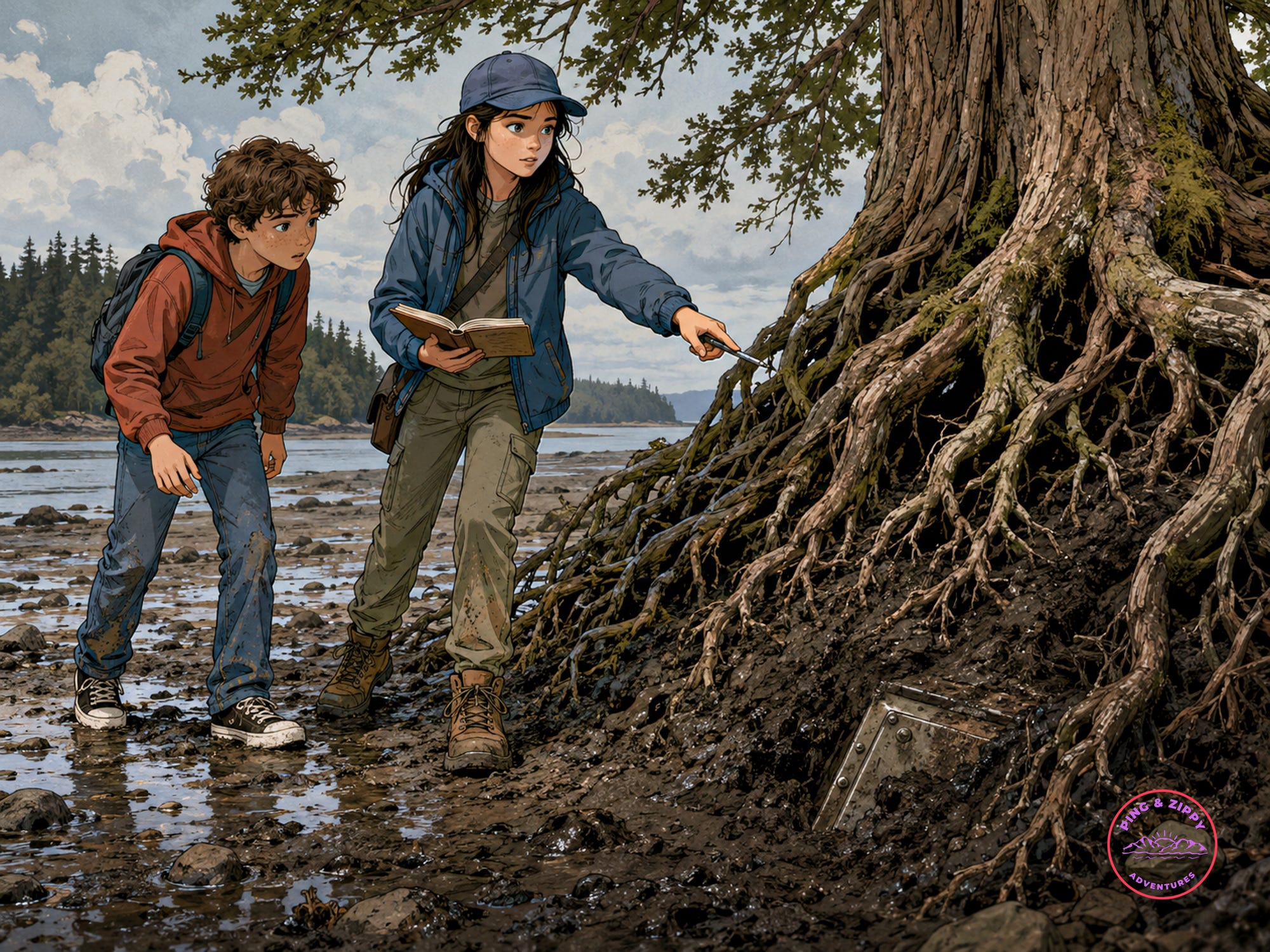
“There,” she said quietly, pointing her pen toward the base of the big cedar.
Ping pushed his messy brown curls out of his eyes and squinted. Half-buried in the soft river bottom, almost perfectly camouflaged against the dark mud, was the corner of something metal.
“Huh,” he said. Then, because he couldn’t help himself: “I wonder how long it’s been there.”
“That’s what we’re going to find out.” Zippy was already writing in her journal. Low tide, north mudflat, cedar point. Metal object, partially buried. Dimensions unknown. She looked up. “Mr. Hendricks said the river shows things during low tide it doesn’t usually show. I think this is it.”
It had started that morning at the bait shop where Ping was buying some unique lures for his Dad’s birthday. Old Mr. Hendricks, who smelled permanently of sardines and knew the Driftwood River better than anyone in town, had caught them studying the tide chart on the wall. He’d tapped the noon entry with one weathered finger.
“Lowest tide of the month,” he’d said. “If you two explorers feel like a walk out to the cedar point on the north mudflat, keep your eyes open.” He’d smiled in that slow, knowing way of his. “Been waiting a long time for the right pair of curious kids to find what’s out there.”
They’d looked at each other. That was all it took.
Now Ping crouched in the mud beside the exposed metal corner and began carefully working around its edges with the small multitool he kept clipped to his belt loop. Zippy stood beside him, documenting every detail, the color of the corrosion, the texture of the remaining canvas wrapped around it, the way the mud released it slowly, almost reluctantly, as Ping worked.
“It’s a box,” Ping said. “Small. Lunchbox size, maybe. The canvas was probably waterproofing, most of it’s rotted, but it did its job.” He worked the multitool gently under one edge. “The latch bolt is iron. Almost completely rusted through.”
“Can you open it without damaging whatever’s inside?”
He gave her a look.
“Right,” Zippy said. “Sorry, how un Ping of me” she smiled her sarcastic smile.
The box came free from the mud with a soft, satisfying sound, like a secret being released. Ping turned it over in his hands, examining the seams, the remaining hinge. “Whoever made this knew what they were doing. The seal is tight. Good construction, interesting size. . . “
“Ping.”
“What?”
“Open it.”
He pressed the multitool under the rusted bolt. It gave with barely any resistance, and Ping lifted the lid.
Inside, wrapped in oilcloth that had kept the damp out far better than it had any right to, were three things: a small brass compass, a smooth river stone, and a folded piece of paper.
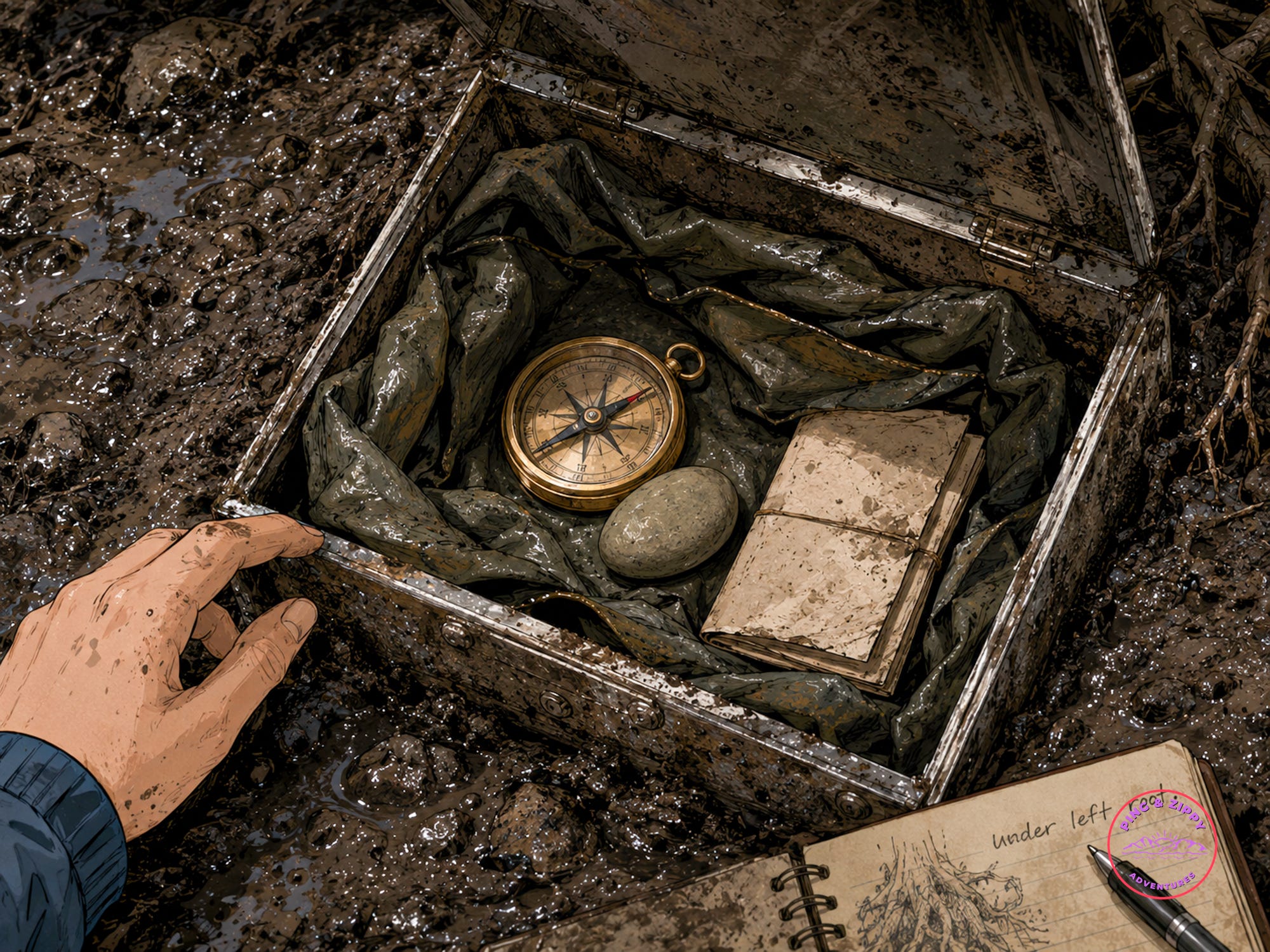
Zippy’s pen was already moving before Ping even reached for the note.
He unfolded it carefully. The paper was old but intact, the handwriting clear and old-fashioned, the ink faded to a warm brown.
‘To whoever the river chooses
This compass belonged to my grandfather, who came to this valley in 1889 and loved this river more than anything in the world. He always said the River keeps her promises, and I believe him. I’m leaving this here because I’m moving away and I cannot take the river with me. But maybe I can leave a little piece of it behind for someone else to love.
The stone is from the deepest part of the channel. He dove for it himself.
Take care of this place.
---Eleanor Marsh, June 1974
The mist had settled around them, soft and quiet. Somewhere across the water, a heron called once and went still.
Zippy read the letter over Ping’s shoulder. For a moment neither of them said anything, which was unusual enough that a passing seagull might have noticed.
Then Ping turned the river stone over in his palm. A single word had been scratched into its surface, worn smooth by decades, but still perfectly legible.
Remember.
“Wow,” Zippy said softly. She looked out at the river, then back at her journal, then at Ping. “Someone left this hoping someone would find it someday.”
“Fifty-two years ago,” Ping said, doing the math automatically. “The oilcloth held. The compass probably still works.” He turned it carefully in his fingers. The needle swung and settled. “Yep. Still works.”
Zippy was writing again, fast and focused. Ping recognized the look, she was already turning this into something, already seeing the story in it the way she always did. He carefully rewrapped everything in the oilcloth and tucked the box under his arm.
“We should bring this to Mr. Hendricks,” he said.
“Definitely.” Zippy didn’t look up from her journal. “Hey Ping, do you think she ever came back? Eleanor? To check if anyone found it?”
Ping considered this with the same seriousness he gave every good question.
“I think she trusted the river to take care of it,” he said finally.
Zippy smiled and closed her journal.
They picked their way back across the mudflat together, the tide already beginning its slow return, the river already folding its next secret quietly back beneath the surface, patient, as it had always been, for whoever came next.
See more of Ping and Zippy mysteries, here on Substack, or see the current book series
Enjoyable as always Bill, thanks for sharing.