

The Centennial Secret
A Ping and Zippy mini-mystery

Note: if you are not familiar with the Ping and Zippy Adventure series characters, here is a quick intro:
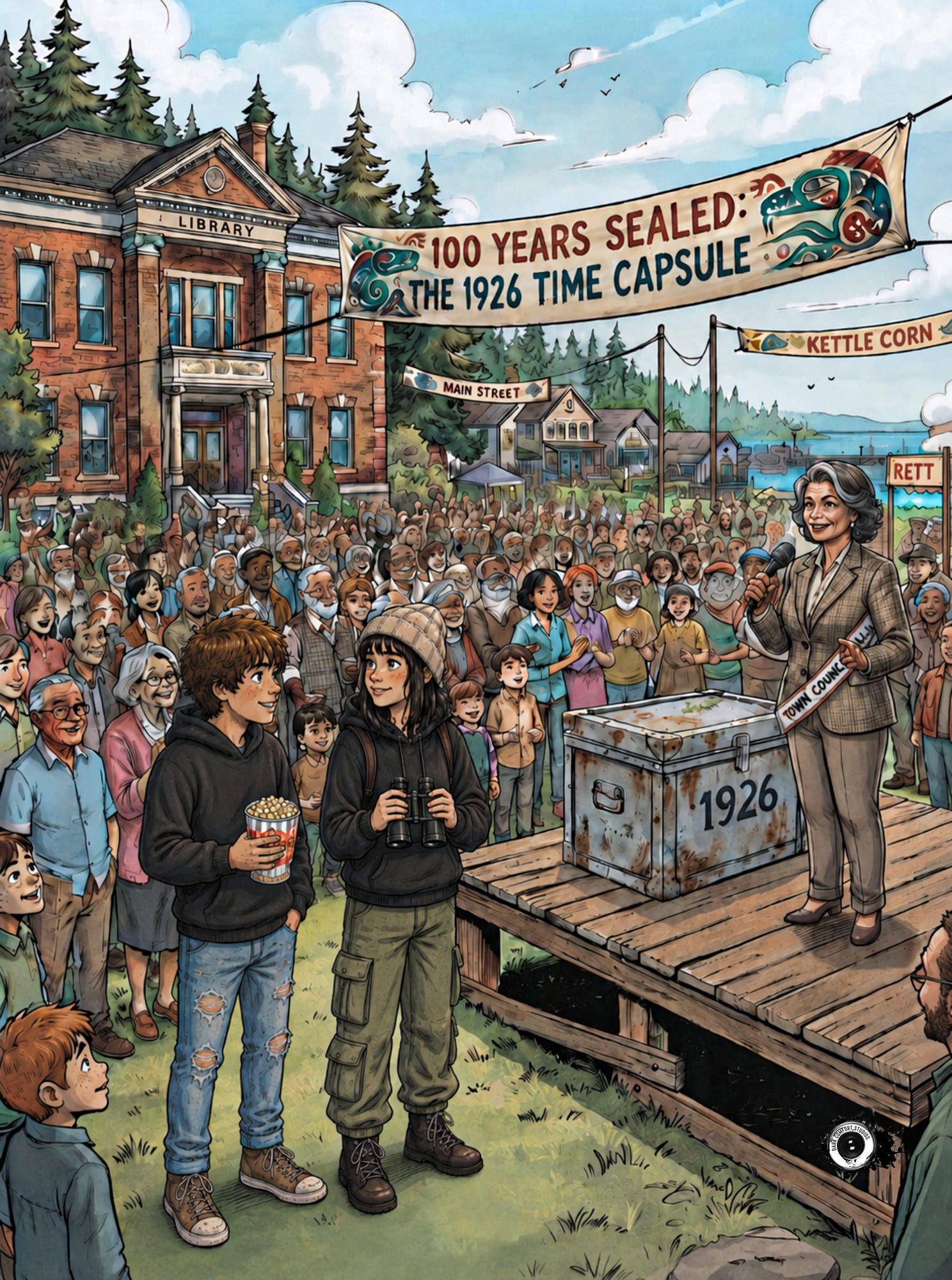
Driftwood Harbor had never seen anything like it. Main Street was strung with hand-painted banners reading “100 YEARS SEALED: THE 1926 TIME CAPSULE,” the smell of Mrs. Alvarez’s famous kettle corn drifted over the town square, and half the county seemed to have crammed onto the courthouse lawn for the single biggest event the town had planned in a decade: the unearthing of the time capsule the town council had buried during that year’s Founders’ Day festivities, exactly one hundred years ago to the day. The town itself was much older, incorporated back in 1886, and had already celebrated its own proper centennial forty years earlier in 1986, with a bicentennial still a lifetime away in 2086. This celebration wasn’t about the town’s age at all. It was about one particular box, and the hundred-year promise sealed inside it.
Ping had never seen his best friend Zippy this excited about anything that didn’t involve a dare, chocolate or a mystery.
“Do you understand what’s about to happen?” Zippy said, bouncing on her toes beside him, her binoculars, which she absolutely did not need for an event happening twenty feet away, pressed to her face. “History. Actual history. Coming up out of the ground. Right now. Today.”
“It’s a metal box,” Ping said. “It’s not going to do a dance.”
“You don’t know that.”
Up on the makeshift stage, Mayor Patricia Kapson tapped the microphone, and the crowd noise dropped to a low, expectant hum. Beside her stood two members of the town’s Public Works crew with shovels, a folding table draped in a commemorative Founders’ Day tablecloth, and, perched slightly behind everyone else and looking oddly tense for a man attending a ceremony he’d clearly been looking forward to for months, former mayor Harlan Griggs, seventy-six years old and normally the sort of man who greeted every event in Driftwood Harbor with a firm handshake and a longer speech than necessary, standing unusually quiet at the edge of the stage with his hands jammed in his jacket pockets.
“One hundred years ago,” Mayor Kapson began, “the people of this town buried a piece of themselves for us to find. Today, we get to meet them.” The crowd cheered. The shovels bit into the soft dirt beside the courthouse steps. Zippy grabbed Ping’s arm so hard he nearly dropped his kettle corn. Ten minutes later, dirt-streaked and grinning, the Public Works crew lifted a rusted metal box the size of a large toolbox out of the ground and set it on the folding table with the kind of reverence usually reserved for the Ark of the Covenant. The mayor pried the latch with a crowbar, the hinges shrieked, and the whole town leaned in as one.
The box was empty.
Not “the seal had failed and everything crumbled to dust” empty. Not “there was one moldy newspaper and some sand” empty. Completely, spotlessly, suspiciously empty, except for a small brass plaque bolted to the bottom that read, in engraved letters: ‘DRIFTWOOD HARBOR TIME CAPSULE: SEALED WITH PRIDE, 1926.’
The silence lasted exactly three seconds before the entire town square erupted into confused, indignant chatter.
“Where’s the newspaper?” someone shouted.
“There was supposed to be a photograph of the original harbor crew!”
“My grandmother’s letter was in there!”
Ping glanced over at former mayor Harlan Griggs. For just a moment, so brief Ping almost missed it, the old man’s face went pale, and his eyes darted toward the empty box like he’d expected something very different to happen.
Zippy saw it too. She always saw everything, even when she pretended not to.
“Ping,” she whispered, lowering her binoculars for the first time all afternoon. “Did you see that?”
“I saw it,” Ping said quietly.
“That is the face,” Zippy said, “of a man who knows exactly where the treasure went.”
“It’s not treasure, Zip. It’s historical documents.”
“Same thing. Documents, doubloons, it’s all just paper with mysteries wrapped in stories.” She was already pulling her notebook out of her back pocket, the one she kept for what she called “official investigations” and Ping called “an excuse to write everything in all capital letters.” “We’re solving this.”
By the next morning, the town’s outrage had calcified into a full-blown scandal. The Driftwood Harbor Gazette ran the headline :
**CENTENNIAL CAPSULE COMES UP EMPTY: TOWN DEMANDS ANSWERS**
and the historical society’s phone had apparently not stopped ringing since sunrise, according to Mrs. Feldman, who was one of the Historical Society volunteers and who Ping and Zippy found looking thoroughly frazzled behind her desk when they walked in that afternoon.
“If one more person asks me if I personally stole the capsule contents,” Mrs. Feldman said, not even looking up, “I am retiring to a cabin with no cell service.”
“We’re not here to accuse you of anything,” Ping said. “We just want to see the original records. Whatever list exists of what was supposed to go in the capsule.”
Mrs. Feldman peered at them over her glasses. “You’re Zelda’s niece,” she said to Zippy, and then, to Ping, “and you’re the boy who won the science fair with the tide chart project.”
“Barometric pressure model,” Ping corrected, “but yes.”
“Well.” Mrs. Feldman sighed, the particular sigh of an adult deciding that two thirteen-year-olds asking sensible questions were probably less annoying than the forty adults who’d called that morning demanding she personally apologize for something she had no part in. “The 1926 committee kept meticulous records. Follow me.”
She led them into a back room stacked floor to ceiling with archive boxes, and after a few minutes of searching, pulled out a thin folder labeled **FOUNDERS’ DAY CAPSULE: CONTENTS, 1926.**
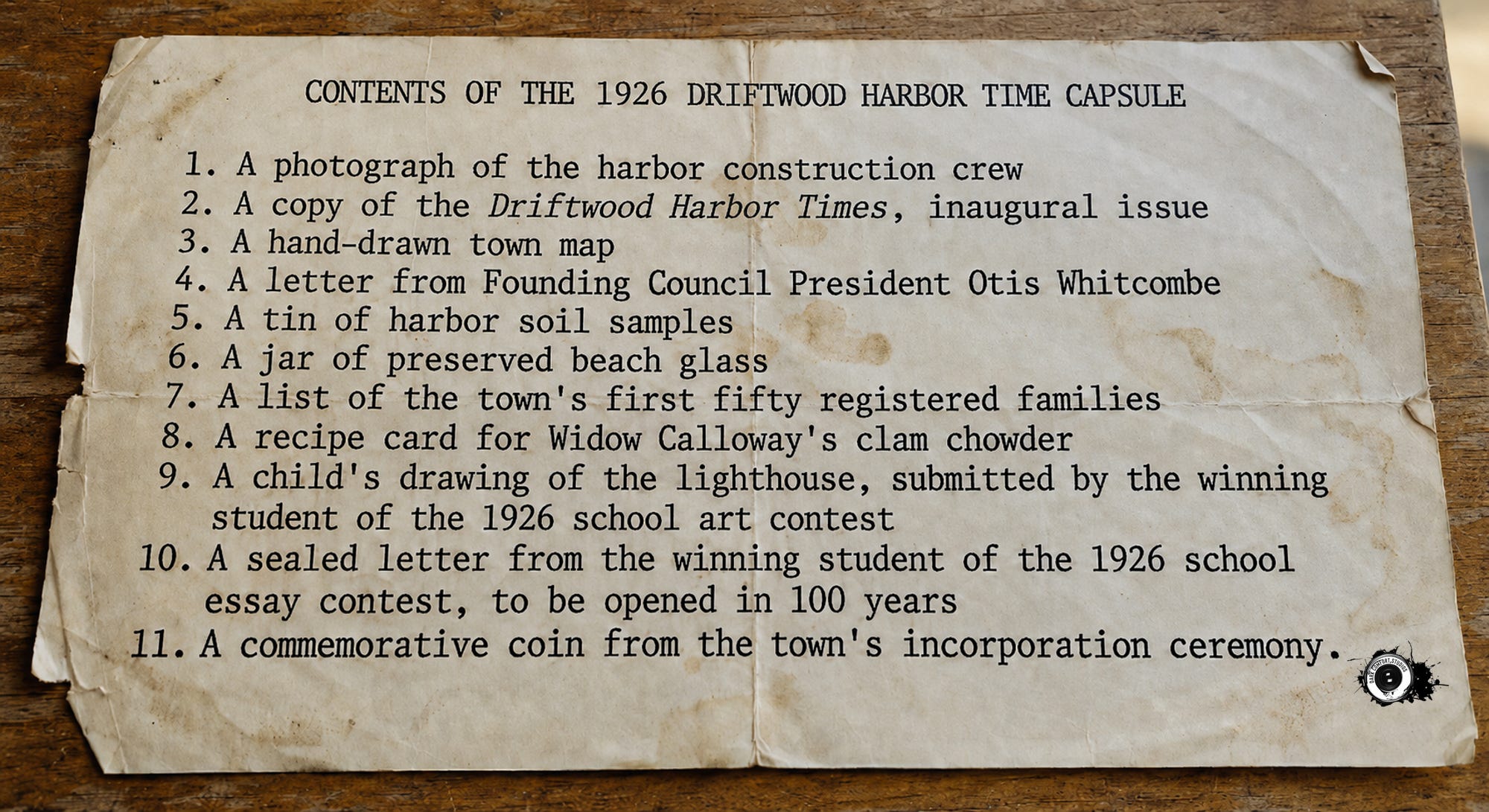
Inside was a single typed page, slightly yellowed, listing eleven items that had supposedly been sealed into the capsule:
1. A photograph of the harbor construction crew
2. A copy of the Driftwood Harbor Times, inaugural issue
3. A hand-drawn town map
4. A letter from Founding Council President Otis Whitcombe
5. A tin of harbor soil samples
6. A jar of preserved beach glass
7. A list of the town’s first fifty registered families
8. A recipe card for Widow Calloway’s clam chowder
9. A child’s drawing of the lighthouse, submitted by the winning student of the 1926 school art contest
10. A sealed letter from the winning student of the 1926 school essay contest, to be opened in 100 years
11. A commemorative coin from the town’s incorporation ceremony
Zippy read through it twice, tapping the page with her pen. “Ping. Number ten.”
“A sealed letter from an essay contest winner,” Ping read aloud. “So?”
“So who won the essay contest?” Zippy flipped to a second page in the folder, a program from the original 1926 ceremony, and ran her finger down a list of names until she found it, and let out a small, triumphant “ha!”
1926 Founders’ Day Essay Contest Winner: Harlan Griggs, age 13.
“That’s not the former mayor,” Ping said immediately. “That’s his grandfather. Same name, three generations running. Everybody in town knows that. He’s the one with the bust outside the harbor office. Helped build the breakwater.”
“Right, obviously.” Zippy waved a hand like she’d known that all along, which she absolutely had not, based on the half-second of blank panic that had crossed her face first. “But think about it, Ping. The grandfather wrote something at thirteen, sealed it for a hundred years, and now the whole capsule’s empty. And our Harlan Griggs, the one who was standing there yesterday looking like he’d seen a ghost, is the only person alive who’d actually care what was inside it.”
Ping felt the pieces click into place with an almost audible sound. “Family reputation,” he said slowly. “If it’s something embarrassing about his grandfather, and his grandfather’s got an actual bronze statue in this town...”
“Then a former mayor has a very good reason to make sure nobody ever reads it,” Zippy finished, snapping the folder shut with a flourish that made Mrs. Feldman visibly flinch. “Ping. I think Harlan Griggs stole from a time capsule to protect his own family.”
“We don’t know that,” Ping said, in the tone of someone who very much suspected it was true but felt somebody in this friendship had to maintain basic investigative standards. “We know his grandfather wrote something at thirteen that might be embarrassing enough for a family to want buried twice. That’s not proof. That’s a motive.”
“Ping. My friend. My colleague.” Zippy put a hand on his shoulder with the gravity of a detective closing a case. “Motive is basically ninety percent of proof.”
“That is not how proof works.”
They found former mayor Harlan Griggs exactly where half the town’s retired residents could reliably be found on a Tuesday afternoon, sitting on the porch of the Sandpiper Diner, nursing a cup of coffee that had probably gone cold an hour ago, staring out at the harbor like it owed him money.
He didn’t look surprised to see them. If anything, he looked like he’d been expecting somebody, eventually, and was mildly relieved it was two kids instead of the Harbor Times investigative reporter, who’d apparently been asking around town all morning.
“Let me guess,” he said, before either of them could speak. “You found the essay contest list.”
Zippy sat down across from him without being invited, which was very on-brand for Zippy. “Mr. Griggs, we don’t want to get you in trouble. We just want to understand what happened.”
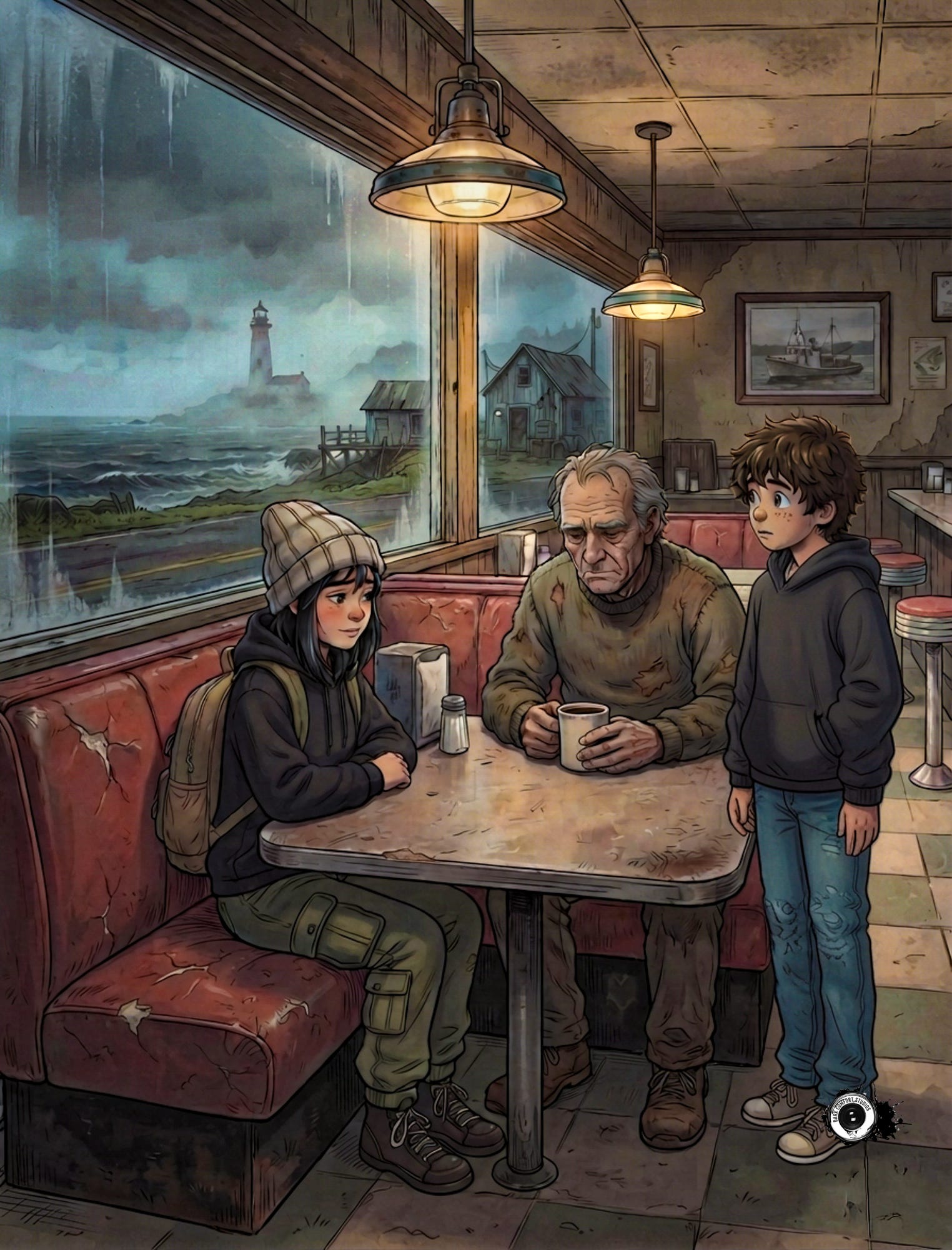
The old man was quiet for a long moment, turning his coffee cup slowly on its saucer. Then, with the air of a man setting down a weight he’d been carrying for a very long time, he said, “My grandfather was thirteen years old in 1926, and he was in love with a girl named Marian Kowalczyk. She was the best writer in their school, by every account, sharper than him, sharper than most of the adults, probably. The essay contest that year was ‘What Driftwood Harbor Means to Me.’ Marian wrote hers first and made the mistake of reading it out loud to him on the walk home, sharing it with someone she liked, the way friends do. My grandfather didn’t have his own essay finished. Contest deadline was the next morning.” He paused, and his jaw tightened. “So he wrote most of hers down from memory that night, changed enough words to make it look like his own, and turned it in. Won first place. Got his name on a bronze plaque and, eventually, a bust outside the harbor office.”
“Wait.” Zippy leaned forward. “Marian just let that happen?”
“No,” Griggs said, and something in his voice went flat and ashamed. “She didn’t. She told the judges it was her essay. She told her teacher. She even wrote a letter to the ‘Times’. Nobody believed her, or nobody wanted to.
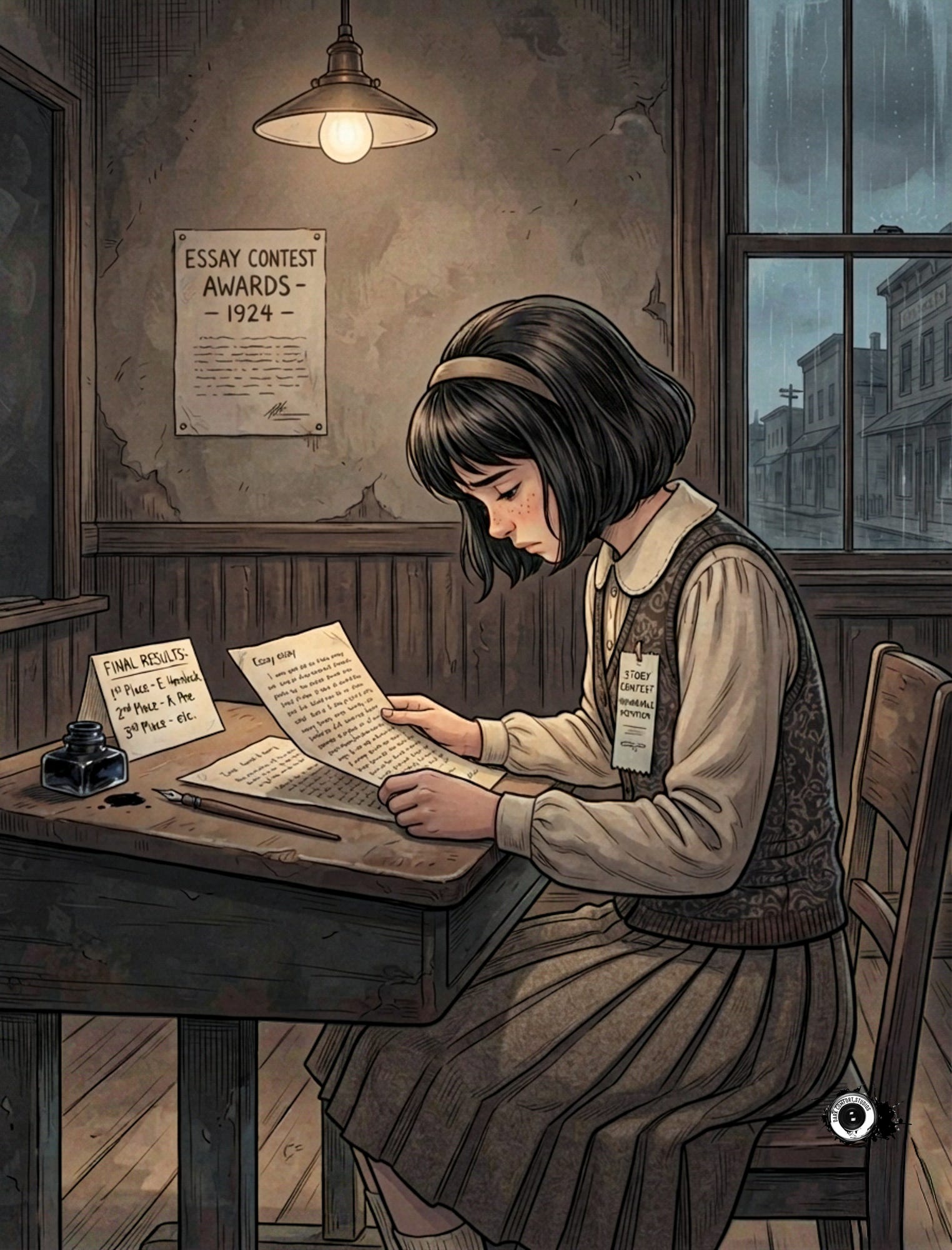
My family had been running half the town’s civic boards for two generations by then. Hers had been in Driftwood Harbor five years. The complaint got written down, and then it got quietly filed away and forgotten, the way inconvenient things did when it was an established family’s word and son, against a newer family’s complaint and daughter.” He shook his head. “She was right, and it didn’t matter, because the right people believed the wrong boy. My grandfather knew it. He knew it every single day for the next sixty-two years.”
Ping felt something cold settle in his stomach that had nothing to do with the ocean breeze. “That’s not embarrassing. That’s actually wrong. And it’s worse that people knew and did nothing.”
“Yes,” Griggs said simply. “It is. My grandfather thought so too, eventually. The diary makes that painfully clear. He couldn’t undo it without admitting to the whole town what he’d done, so instead he wrote a private confession, tucked it inside the sealed letter along with the original prize-winning essay everyone expected to find, and buried the truth for a hundred years, hoping it wouldn’t matter to anyone by the time it surfaced.” Griggs’s hands tightened around his coffee cup. “He was wrong about that too. It still matters. Marian’s family is still here. Her name should have been on that plaque a hundred years ago, and it should have happened the week she asked for it, not a hundred years later because two kids went digging.”
“It wouldn’t happen like that today,?” Zippy said, and it wasn’t really a question.
“No,” Griggs agreed. “It wouldn’t. A girl who could prove she wrote something better than the boy standing next to her wouldn’t need a newspaper editor’s permission to be believed anymore. She’d have the whole internet on her side by lunchtime. That’s not a small thing. It just came about seventy years too late to help Marian.”
“But your grandfather’s been gone a long time,” Ping said. “How did you find out what was in it?”
Griggs let out a long breath. “He kept a diary. Found it in a trunk in his attic after he passed, back in 1988. I was clearing out the house. There’s an entry from 1926 that isn’t proud at all, describing exactly what he’d done and how ashamed he was, and another one, decades later, admitting he’d written a full confession into the sealed letter because he was too much of a coward to say it to anyone’s face while he was alive.” Griggs set his cup down, hard enough that it rattled. “My grandfather was, by every other account, a serious, respected man. Helped build the town’s breakwater. Sat on every civic board this town ever had. There’s, as you know, a bronze bust of him outside the harbor office crediting him, in bronze letters, with an essay he didn’t write. I found that diary entry three months before my first run for mayor. I told myself the town didn’t need its founding story rewritten and its favorite civic hero exposed as a fraud, not on my watch, not right as I was asking people to trust me. I told myself it wasn’t my lie to confess.”
“And you became mayor,” Ping said, following the thread. “Which meant you had access to things when construction happened nearby, or...”
“Nineteen ninety-four,” Griggs said. “I was forty-four years old, a councilman with an eye on the mayor’s office, and the county wanted to run new water lines directly under the courthouse lawn. I volunteered, very generously, I thought at the time, to personally oversee moving the capsule during construction, ‘for historical preservation purposes.’ ” He allowed himself a small, guilty smile. “It is remarkably easy to open a box when you’re the one holding the crowbar and nobody thinks to ask why.”
“You took the letter,” Zippy said. “But you left everything else?”
“I took the letter,” Griggs confirmed. “That was all I meant to take, I swear it. But then I realized that if just one item turned up missing from a sealed, witnessed, publicly buried capsule, the first question anyone would ask is which one, and the answer would point straight at my grandfather. A missing letter from the one person whose grandson happened to be on the council overseeing the whole thing? That’s not subtle. So I told myself if nothing came back, nobody could single anything out. I took the coin next, telling myself I’d replace it with something similar later. Then I panicked again, because now two things were missing instead of one, and a man who’s already stolen two items from a time capsule isn’t in a position to carefully put things back without making it worse.” He spread his hands helplessly. “So I just kept going. Took everything. Resealed the box exactly as it looked. Told myself I’d figure out the right way to fix things before the hundred years were up. And then thirty more years went by, during the time, I stopped being mayor, my life spiraled a bit, and somehow I never quite found the courage to do it.”
Ping blinked. “So where is all of it? The photograph, the map, the recipe card, everything?”
“In a fireproof box in my garage,” Griggs said, looking, for the first time since they’d sat down, thoroughly ashamed of himself. “Wrapped in the same newspaper it came in. I told myself for thirty years that I was protecting my grandfather’s memory. Truthfully, I think I was just protecting mine.”
Zippy, who had gone unusually quiet, finally spoke. “Are you gonna tell people the real reason? All of it, not just the easy part?”
Griggs looked down at his coffee for a long moment. “I have to,” he said. “Marian never got to see this made right while she was alive. The least I can do now is make sure it happens, uncomfortable or not.”
They didn’t just take his word for it. That afternoon, Ping and Zippy went straight back to the historical society and asked Mrs. Feldman if there was anything else filed under 1926, anything that hadn’t made it into the neat, official folder.
Mrs. Feldman raised an eyebrow, disappeared into the back for nearly twenty minutes, and came back with a much thinner, much dustier folder that had clearly not been opened by anyone in decades. Inside was a single handwritten letter, addressed to the editor of the Driftwood Harbor Times, dated three days after the 1926 essay contest results were announced. The handwriting was careful and precise, a thirteen-year-old’s best effort at sounding like an adult who deserved to be taken seriously.
‘I am writing to state that the winning essay in this year’s Founders’ Day contest was not written by Harlan Griggs. It was written by me. I read it aloud to him myself the night before it was due, and he copied it. I told Mrs. Ferris and Principal Dunmore and neither believed me, and I do not expect you to publish this, but I wanted it written down somewhere, so that it would exist. Signed, Marian Kowalczyk, age 13.’
Stamped across the bottom, in red ink that had faded to rust: **NOT PUBLISHED. NO FURTHER ACTION.**
Zippy read it twice, and for once in her life, didn’t say anything sarcastic at all.
“She knew exactly what happened to her,” Ping said quietly. “And she made sure it wouldn’t just disappear.”
“It almost did anyway,” Zippy said. “For a hundred years.”
“Not anymore,” Mrs. Feldman said, taking the letter gently from Zippy’s hands to have it properly preserved. “Not after this.”
The town meeting that Friday was, by unanimous agreement, the single most talked-about evening Driftwood Harbor had experienced in years. Former mayor Harlan Griggs stood at the podium, pale but resolute, and returned every single item to Mayor Kapson, including the photograph, the map, the recipe card (which the diner immediately begged to put on the menu), and the coin. Then he asked, in a voice that had lost every ounce of its usual boom, whether he could read something aloud himself, rather than have someone else do it.
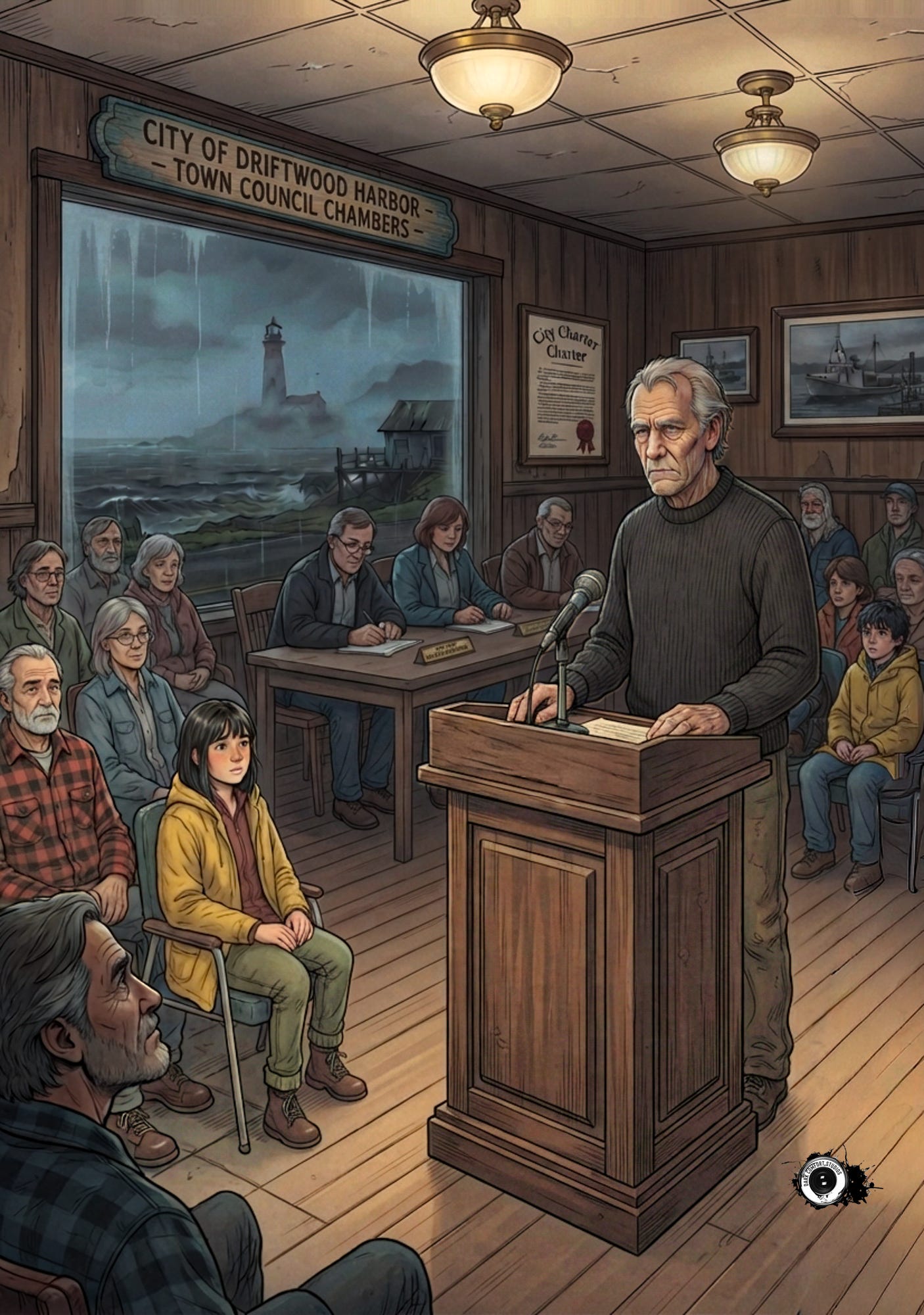
He read his grandfather’s original 1926 essay first: the one that had won first place, the one whose opening lines about tide pools and the smell of low-tide salt turned out to be, word for word, achingly familiar to at least one person in the crowd once she’d heard it. Then he read the confession his grandfather had folded in beside it: a shaking, decades-later admission, written in a much older hand, of exactly what a scared, love-struck thirteen-year-old boy had done to a girl who trusted him enough to read her homework out loud on a walk home.
For a long moment, nobody said anything at all.
Then Mrs. Feldman stood up from her seat near the front, holding a small, folder of her own, and asked if she could add something to the record.
She read Marian’s letter to the Harbor Times aloud, word for word, in the same steady voice she used for reading anything she believed deserved to be taken seriously, right down to the line about not expecting it to be published, just wanting it written down somewhere so it would exist. When she got to the red-inked stamp at the bottom, ‘NOT PUBLISHED. NO FURTHER ACTION’, a woman near the back of the crowd made a small, sharp sound and pressed a hand to her mouth.
That was Ruth Kowalczyk-Ames, Marian’s granddaughter, who ran a quilting shop two towns south and had driven in that morning after a bewildering phone call from a Times reporter, mostly out of curiosity. “She told us she’d written something she was proud of once,” Ruth said, standing, her voice not quite steady. “She never told us anybody hadn’t believed her. She just said it ‘didn’t work out.’ I always thought she meant she’d lost the contest fair and square.”
“She didn’t lose anything,” Ping said, quietly, but the microphone Mayor Kapson had handed him without asking picked it up anyway. “She won. Just nobody wanted to believe her.”
Mayor Kapson, visibly moved, motioned for quiet and then said the historical society would begin the process of updating the official 1926 record, crediting Marian Kowalczyk as the true author effective immediately, and, after a beat, added that the harbor office bust might need a companion plaque. A rather large one.
Zippy, who had been unusually quiet through the whole reading, leaned over to Ping and whispered, “Okay, this got a lot heavier than a bad poem.”
“There wasn’t a poem,” Ping whispered back.
“There should have been. Would’ve balanced things out.”
Afterward, sitting on the courthouse steps with paper cups of Mrs. Alvarez’s kettle corn, Ping and Zippy watched the town square slowly empty out, still quiet with the kind of thoughtful hush that follows a room finding out something true instead of something funny.
“So,” Zippy said eventually. “Case closed. No treasure. Just a hundred-year-old lie and a very overdue apology.”
“I told you it wasn’t treasure.”
“It was better than treasure, honestly,” Zippy said, popping a piece of kettle corn into her mouth. “Treasure’s just gold. This was gold and justice. Ruth’s grandma finally gets her name on something. That’s a pretty good ending.”
Ping considered this, the way he considered most things, carefully, and a beat too late to seem casual about it. “Yeah,” he admitted. “That part was actually kind of great.”
Zippy was quiet for a second, which for Zippy counted as a significant event. “You know what gets me,” she said. “Marian did everything right. She told the truth, to who she thought were the right people, right away. And it still took a hundred years and two thirteen-year-olds to fix it.”
“Wouldn’t happen now,” Ping said. “Not like that.”
“No,” Zippy agreed. “Now she’d have posted the whole essay online, herself, side by side with his, before the judges even finished lunch. People would’ve believed her in about four minutes.” She considered that, looking pleased with the world for a second. “I like that better.”
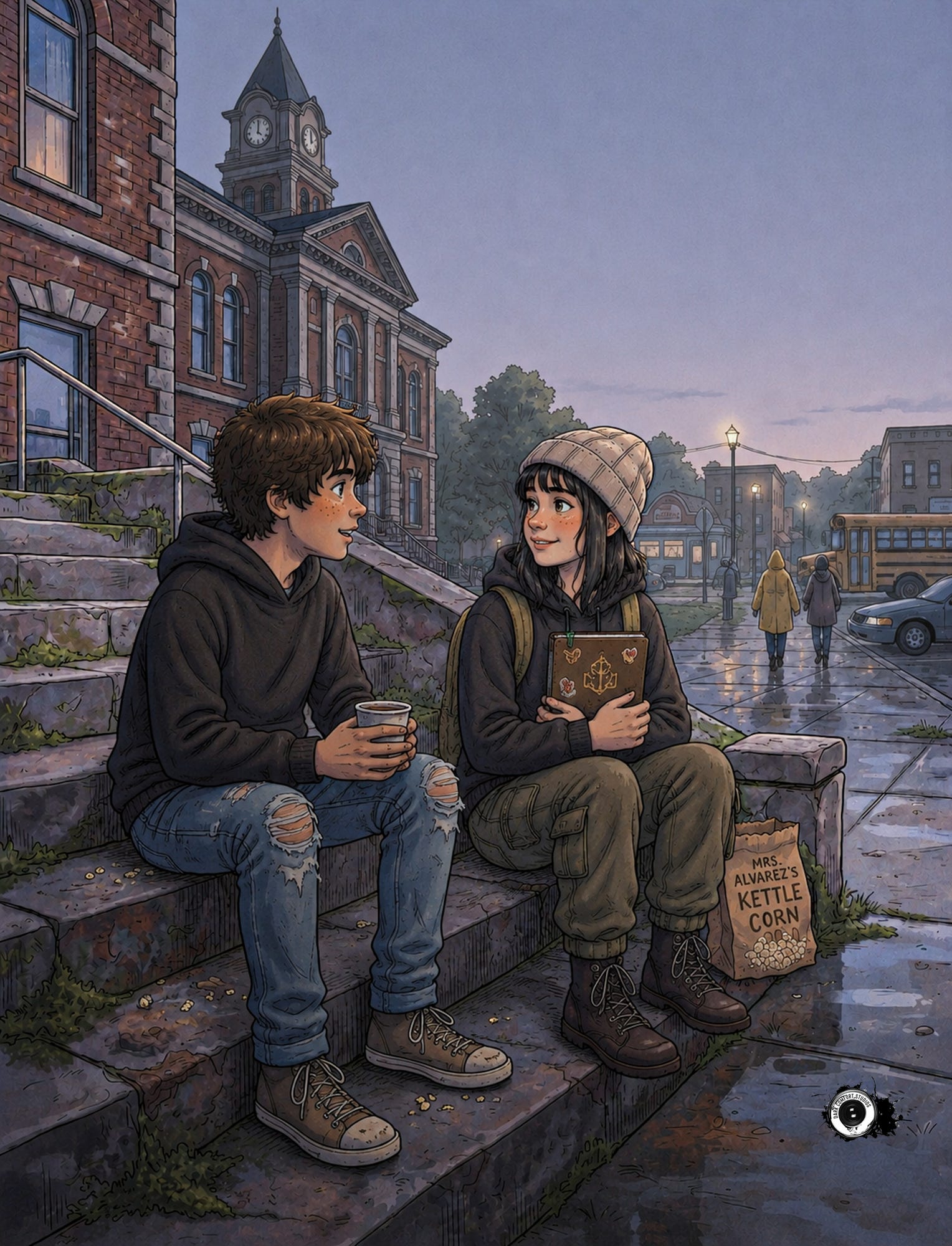
Zippy let the moment sit for exactly two seconds before ruining it entirely. “You know what the weirdest part is? In a hundred years, some kid is gonna dig up whatever we decide to bury for the bicentennial, and they’re gonna find out something embarrassing about one of us.”
Ping considered this with the particular seriousness he brought to most things. “Then we should be very careful what we write down.”
“Speak for yourself,” Zippy said, already pulling out her notebook, with a sparkle in her eye, grinning, already writing, in careful, deliberate, all-capital letters across a fresh page: *CASE FILE: THE CENTENNIAL SECRET, SOLVED BY ZIPPY (AND PING, I GUESS).*
Ping read it upside down, sighed, and didn’t bother arguing.
Zippy laughed and got up, Ping followed
Some things, were probably never going to change.
The End
As of this writing the Ping and Zippy Adventure Series has 3 books with another on the way. The series in available on Amazon
© Bposner Publishing. All images are AI generated
This is the first of Ping and Zippy mini-mysteries that are used to work out scene ideas for the larger books. Feedback and comments are appreciated.
I enjoyed this Bill. It reminded me of the mysteries I read when I was younger and watching Scooby Doo cartoons only much better :)
I especially liked the contrast between the old time capsule and how things were back then and the reflection on how a positive use of technology/the online world would have yielded a different result.